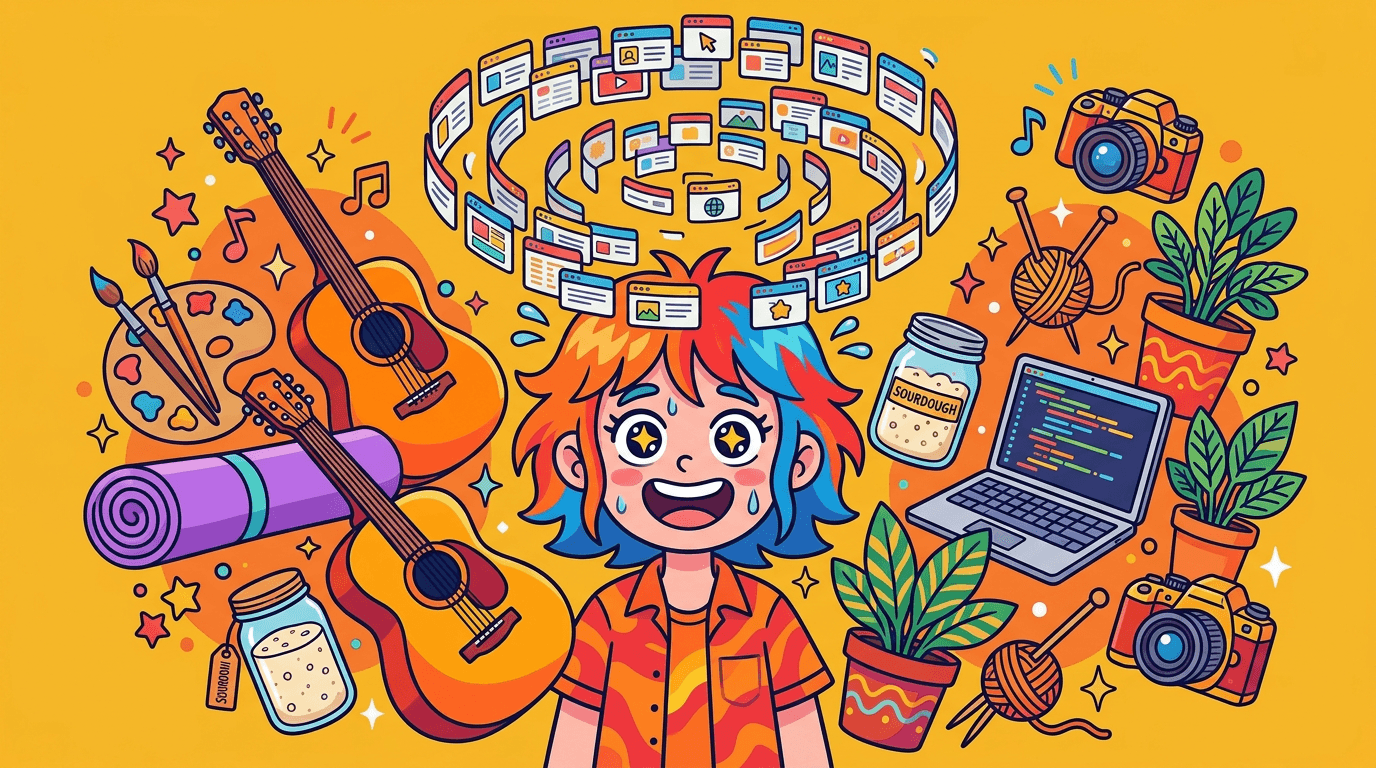
Last month you were going to learn Japanese. This month it's sourdough. Next month? Who knows. Your brain's novelty engine hasn't dropped the next obsession in your lap yet, and you're getting antsy.
Being The Hyperfixation Addict means your brain treats new interests like emotional painkillers — powerful, fast-acting, and absolutely devastating when the supply runs out. The moment life gets uncomfortable, your brain doesn't reach for rest, retail, or a cleaning product. It reaches for something shiny. Something new. Something that requires just enough cognitive bandwidth to completely drown out whatever feeling you were trying to avoid. And for a few days or weeks, it works beautifully. You're not anxious — you're busy. You're not depressed — you're passionate. You're not running from your problems — you're running toward pottery.
The psychology here maps onto what researchers call "experiential avoidance" — the tendency to avoid unwanted internal experiences (thoughts, feelings, memories) by replacing them with intense external engagement. You're not actually interested in becoming a beekeeper. What you're interested in is the neurochemical cocktail that comes with the novelty phase of learning: dopamine, norepinephrine, and the sweet, sweet illusion that this time it's different. This time it's your thing. This time it'll stick.
It never sticks. And that's not a character flaw — it's the mechanism working as designed. The coping strategy requires novelty. Once the new thing stops being new, it stops serving its function as an emotional distraction, and your brain drops it like a hot potato and goes hunting for the next fix. That graveyard of abandoned hobbies isn't evidence of flakiness. It's a breadcrumb trail of every emotional crisis you've had for the last five years, each one marked by a new set of equipment you bought and used exactly three times.
The money isn't even the worst part. The worst part is the identity confusion. When you cycle through interests that rapidly, you never actually develop a deep sense of who you are or what you care about. Are you a runner? A painter? A coder? A plant parent? You're all of them and none of them, a Wikipedia page with a hundred surface-level entries and no deep dives. People describe you as "interesting" or "someone who's into a lot of things," and you take it as a compliment because the alternative — admitting you're too scared to go deep on anything in case it disappoints you — is too real to sit with.
The relationship pattern is adjacent. Hyperfixation Addicts sometimes treat people the same way they treat hobbies. The early stage of a friendship or romance is intoxicating — all novelty, all dopamine, all attention. Then it becomes routine, and the same restlessness kicks in. You might not leave the relationship, but your attention drifts. You're physically present but mentally already researching your next new thing. The people around you can feel it, even if they can't name it.
What connects all of this is a deep discomfort with stillness. You don't do nothing well. Silence is unbearable. Boredom is an existential threat. And somewhere underneath all the hobbies and projects and 47-tab browser sessions is a version of you that's terrified of what happens when there's nothing left to distract you from... yourself.
The growth edge isn't about committing to one hobby forever. It's about learning to notice the moment when the switch flips — when a genuine interest starts being driven by avoidance rather than curiosity. When you can catch yourself saying "I'm SO into this new thing" and honestly assess whether you're excited or escaping. Because sometimes it's both, and knowing the ratio is the difference between a fulfilling life and a very well-stocked craft room you never enter.
Sit with the boredom. Just once. Not to fix it, not to optimize it, not to podcast-it-away. Just... be in it. The thing you're running from might actually be less scary than the running.