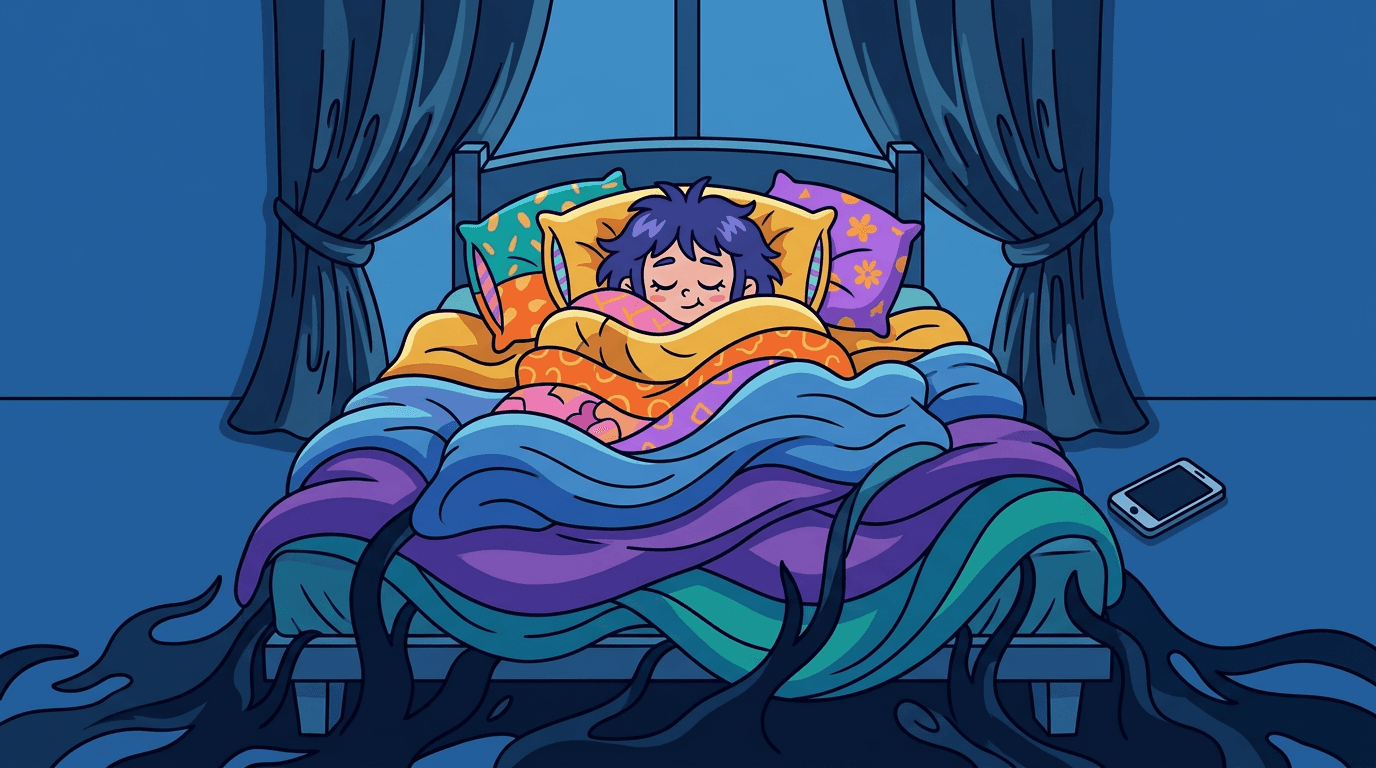
You didn't choose sleep. Sleep chose you. And at this point, you two are in a committed relationship that your friends are genuinely concerned about.
Being The Bed Rot Specialist isn't about being lazy — and honestly, if one more person suggests you "just get up earlier" you might file a strongly worded complaint with the universe. This is about your brain discovering that consciousness is optional, and unconsciousness is significantly less painful. Why face your problems when you could simply... not be awake for them? It's a strategy. A terrible strategy, but your brain committed to it with impressive dedication.
What's actually happening here is a textbook avoidance coping mechanism, and it's more psychologically complex than people give it credit for. Excessive sleep — or more accurately, excessive time in bed, because let's be honest, you're not always sleeping — functions as a withdrawal response to emotional overwhelm. When your nervous system gets flooded with more stress than it can process, it basically hits the emergency shutdown button. You're not napping. You're dissociating horizontally.
The neuroscience is annoyingly logical. When you're stressed, your body produces cortisol. Sustained cortisol elevation is exhausting — literally. Your body burns through serotonin trying to regulate the stress response, and guess what serotonin depletion causes? Fatigue. So your brain isn't being dramatic. It's genuinely running out of the neurochemical fuel it needs to keep you functional. The bed isn't an escape — it's a refueling station. The problem is you've confused the refueling station for a permanent residence.
There's also the avoidance piece, and this is the part that stings. Every hour you spend in bed is an hour you don't have to make decisions, face people, or deal with the cascading pile of responsibilities that grows larger the longer you avoid it. And here's the cruel irony: the avoidance creates more things to avoid. Missed deadlines. Unanswered texts. Plans you bailed on. Each one adds another brick to the wall between you and the outside world, which makes the bed feel even more necessary. It's a feedback loop designed by the devil's own engineer.
Your relationships take a specific kind of hit too. You're not dramatic about it — you just... disappear. Friends stop inviting you places because you've cancelled the last seven times. Romantic interests get confused because you seem interested one day and completely unreachable the next. You're not ghosting anyone on purpose. You're just haunting your own bed, and everyone else is collateral.
The "bed rotting" trend on social media did you absolutely no favors, by the way. It took what is essentially your brain's emergency shutdown protocol and rebranded it as an aesthetic. Suddenly your coping mechanism had a hashtag and a cozy blanket sponsorship. But there's a difference between a deliberate rest day and waking up at 4 PM for the third time this week unable to account for where the time went. One is self-care. The other is your psyche hitting the eject button on your life.
The growth path for The Bed Rot Specialist isn't about forcing yourself into a 5 AM routine or signing up for sunrise yoga. That's violence. The real move is building what psychologists call "behavioral activation" — starting absurdly small. Not "go for a run." More like "sit up in bed." Then maybe "stand near the window." Then eventually "exist outside the bedroom for 20 minutes." The goal isn't to become a morning person. The goal is to prove to your nervous system that being awake doesn't have to be a full-time threat.
Your bed will always be there. It's a very patient partner. But it's also not going to tell you the truth, which is this: the rest you're getting isn't rest. It's hiding. And hiding gets less comfortable the longer you do it, no matter how good the pillows are.