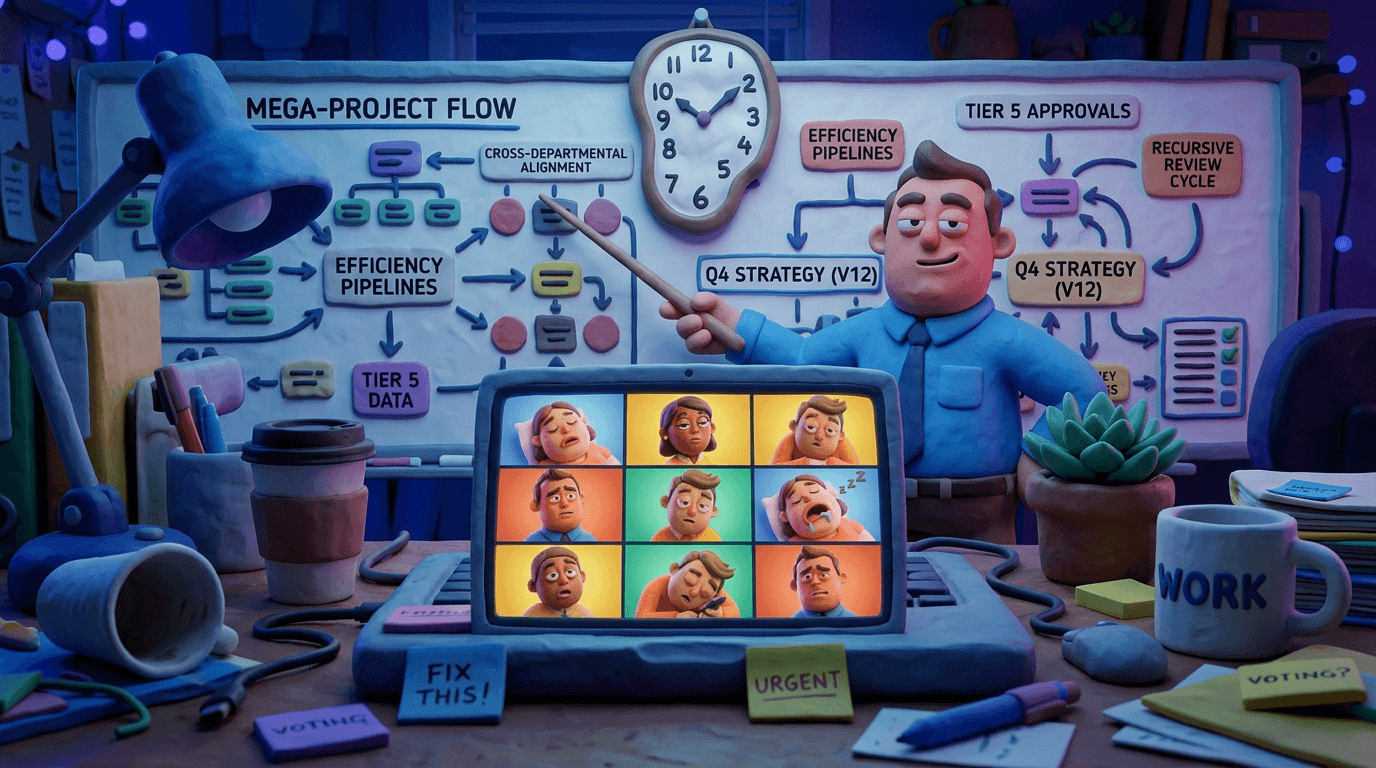
You are the reason people have "hard stops." Not in a vague, general sense — literally, specifically you. Your coworkers invented fictional follow-up meetings just to have an excuse to escape your gravitational pull. The phrase "I just have one more thing" coming out of your mouth triggers a fight-or-flight response in anyone who's been in more than two meetings with you.
Let's trace your origin story. The Time Thief doesn't set out to steal time. In your mind, you're being thorough. Responsible. Proactive. When you extend a meeting to cover "just one more thing," you genuinely believe you're saving future time by addressing it now. When you assign action items in the last three minutes, you think you're driving accountability. When you turn a 30-minute check-in into a 90-minute strategy session, you believe — with your whole chest — that this is leadership.
The psychology here is actually fascinating. Time Thieves typically score high on what researchers call "need for closure" — a personality trait characterized by a strong desire to reach definitive answers and avoid ambiguity. You can't leave a meeting with loose threads. Every question needs an answer before the call ends. Every potential issue needs a plan. The idea of saying "Let's take that offline" feels like failure to you, like admitting the meeting didn't accomplish enough. So you keep going. And going. And everyone's lunch gets cold.
There's often a control element too. The Time Thief tends to be someone who feels most comfortable when they're driving the agenda — even when it's not their meeting. You ask the follow-up questions. You propose the frameworks. You suggest the working groups. You're the person who says "Before we go—" when everyone has already mentally left. And the really insidious part? Nobody pushes back, because you deliver it with enough authority that people assume maybe this IS important enough to stay for.
Your coworkers' experience of you is a slow-building dread. It starts when they see the meeting invite is 30 minutes — they know it won't be. It intensifies when you unmute at the 25-minute mark. It peaks when you share your screen to show "just one more slide." The group chat is on fire. Someone has started a countdown. The meeting organizer has lost all control, and honestly, they lost it the moment you joined.
Here's the part that probably stings: you're often the most competent person in the room. The Time Thief is rarely a slacker. You care about outcomes, you think in systems, and you're usually trying to prevent problems that nobody else has even considered yet. Your intentions are genuinely good. The issue is that your definition of "productive meeting" is wildly different from everyone else's, and you've never stopped to check whether your version is the only valid one.
Your growth edge is radical time discipline. Set a physical timer. When the meeting is scheduled to end, it ends — even if you have more to say. Practice the art of the follow-up email. Learn to love the parking lot. The hardest thing for you to accept is that not every thread needs to be resolved in real-time, and that a good meeting isn't measured by how much it covered but by how energized people are when they leave. Nobody is energized when they leave your meetings. They're just tired. Fix that, and your thoroughness becomes an asset instead of a hostage situation.