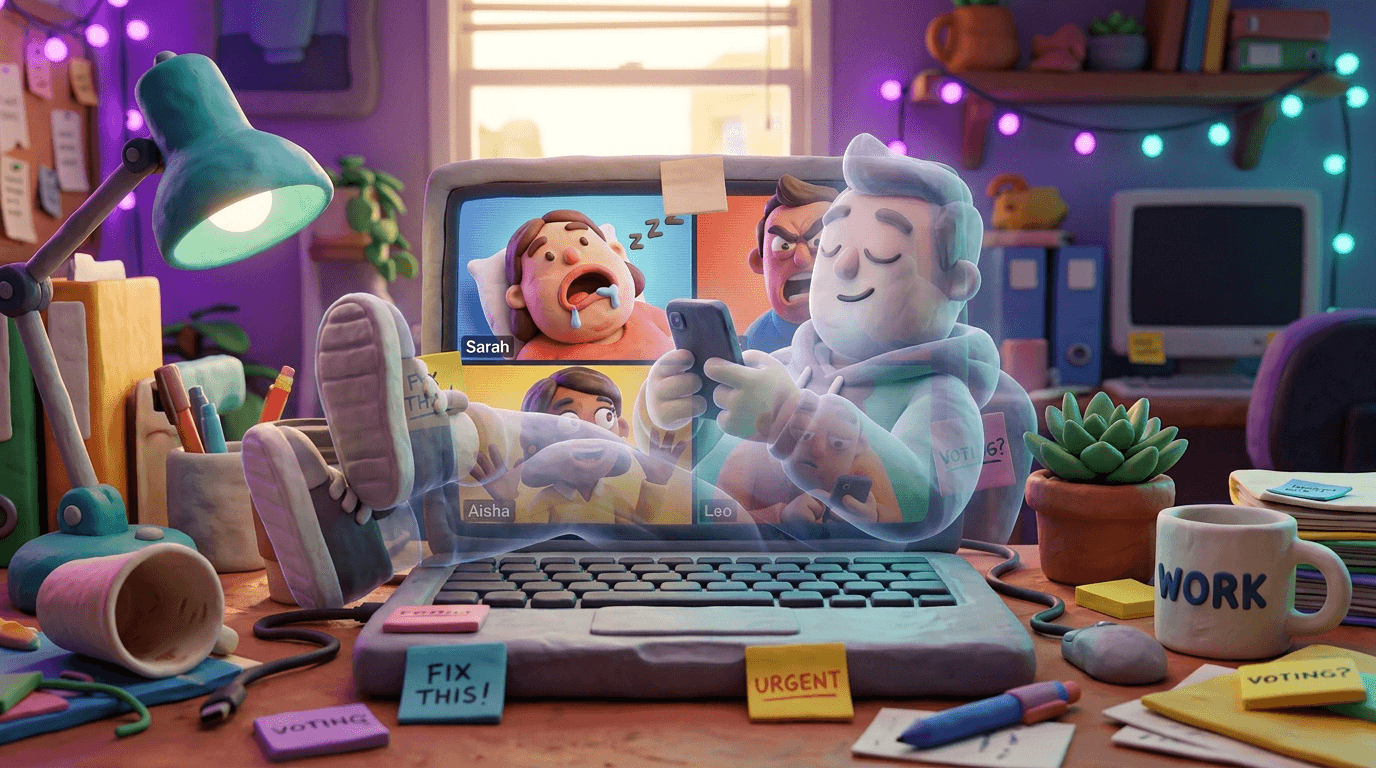
So your meeting monster origin story is... you simply stopped showing up. Not physically — you're there. Your little green dot is active. Your name is on the participant list. But mentally? Emotionally? Spiritually? You checked out somewhere around your 400th standup and never checked back in.
And honestly? It's kind of genius. While everyone else is fighting for airtime, performing engagement, and stress-sweating through presentations, you've achieved a state of corporate nirvana that Buddhist monks would respect. You've mastered the art of the strategic mute button, the plausible-deniability camera malfunction, and the perfectly timed "Sorry, you cut out — can you repeat that?" when someone calls on you directly.
Here's the psychology behind your phantom existence: what you're doing is a textbook withdrawal response to overstimulation. Organizational behavior research calls it "meeting disengagement," and it's actually one of the most common coping mechanisms in meeting-heavy workplaces. Your brain did a cost-benefit analysis of active meeting participation and decided the ROI was absolutely not worth it. And the data kind of backs you up — studies show that the average employee spends 31 hours per month in unproductive meetings. Your brain just... opted out of the unproductive part.
The thing is, your phantom tendencies aren't laziness. They're efficiency wrapped in apathy wrapped in a very comfortable hoodie that's just below your camera frame. You've figured out that 90% of what happens in meetings could have been a Slack message, and you're living your truth. You still deliver your work. You still hit deadlines. You just refuse to perform productivity in a meeting setting when you could be actually being productive somewhere else (or, let's be real, watching TikTok — but that's between you and your screen time report).
Where this gets tricky is the perception game. Your coworkers have started to notice. Not because your work suffers — it doesn't — but because your absence has a presence of its own. When someone says "What does everyone think?" and there are three seconds of silence where your contribution should be, people feel it. Your manager has probably made a mental note. That "Can you turn your camera on?" request wasn't random.
The phantom's kryptonite is the small meeting. You can disappear in a 20-person all-hands, but a 4-person brainstorm? You're exposed. No crowd to hide in. No buffer of other people's voices to cover your silence. And when you're forced to engage, the whiplash is real — both for you and for your colleagues who forgot you had opinions.
Your growth edge isn't about becoming a meeting enthusiast. That would be unhinged. It's about strategic visibility — picking the two or three meetings a week where your input actually matters and showing up fully for those. Let the rest stay on mute. The phantom doesn't need to haunt every room, just the ones where being seen actually moves the needle. Save your energy for the meetings that matter, and let the rest of the calendar invites fear your "Decline" button.